Saturday, October 31, 2009

October ground Skink (Scincella lateralis) and Other Finds on A Walk

This little Ground Skink skittered across the dirt road we were walking on the other day. One thing I like about Georgia is herps and other "cold-blooded" critters being active this late in the year (well, not the ticks and chiggers and fire ants). Other finds along this walk are pictured below...

Another view of the skink:

October ground Skink (Scincella lateralis)

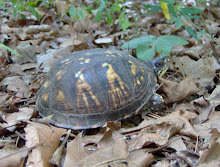
A little Stinkpot, spotted by our dog:

October Stinkpot (Sternotherus odoratus)

A faded Buckeye perched on some gone-to seed member of the Asteraceae in a meadow that was teeming (by my standards) with butterflies:

Late October Buckeye

Sunday, October 11, 2009

Green Anole on Yellowing Tulip Tree Leaf

I think that Kermit the frog was actually based on a Green Anole (Anolis carolinensis). Jim Henson grew up in Mississippi, so he certainly had the opportunity to observe these winsome and entertaining insectivores. They're still active and I have seen quite a few this weekend, incuding a tiny hatchling. They are found in the wild throughout the Southeast, as well as in pet shops elsewhere. These animals remain relatively common due to their tolerance for human-caused disturbance (up to a point). There is some evidence that the introduced Brown Anole (Anolis sagrei) may negatively impact their populations. They are a common species that I would like to see stay common.

Sunday, October 4, 2009

White Morpho


White Morpho, originally uploaded by Turtelle.

This image of Morpho polyphemus is popular on my Flickr site. People seem to like how he (or she--I can't tell) appears to be looking at the camera, though that makes me think of the Far Side cartoon of the last thing a fly ever sees (one of Gary Larsen's trademark overweight women wearing cat-eye glasses and weilding a fly swatter, repeated as innumerable octagon-shaped tiles) only the view is me and my Pentax.

I think that this particular individual has somewhat crumpled wings, like it didn't emerge quite right. In the butterfly house there aren't any predators, so the butterfly's lifespan is probably unaffected.

Saturday, October 3, 2009

EBT Nest With NINE Eggs!

Read about it here, complete with video of hatchlings! Amazing!

Owl Butterfly on tree Trunk Close Up

Another photo from the butterfly house at Callaway Gardens. I believe the species is Caligo memnon. Insect eyes are so inscrutable. What do they see?

Wednesday, September 30, 2009

Heliconius sp.


Heliconius sp., originally uploaded by Turtelle.

Went to the Callaway Gardens butterfly house last week. I'm not sure what species this is other than that it is some type of longwing. It didn't match any of the species in the little guides that were provided. A couple of butterflies seemed to be obsessed with laying eggs on my camera, which was pretty strange. I wonder if these butterfly houses are allowed to provide them with their appropriate host plants. I'm pretty sure that they have to buy chrysales from licensed dealers and it may be illegal to breed exotic butterflies, so not providing host plants would prevent successful breeding.

Its great to be able to observe so many individuals of species I wouldn't otherwise see. Photographing them is still a challenge, even though they are in captivity, but not quite as difficult as photographing them in the wild. It was Blue Morpho Month, but I'm not sure that I got any Blue Morpho pictures. I got numerous photos of what I think are Owl Butterflies, a species that looks somewhat similar, and is even blue on the dorsal surface, but I'm no lepidopterist...

Tuesday, August 25, 2009

Chomper Meditating


Another cat portrait with the 90mm. I hope to try it out on turtles and butterflies over the next couple of days.

Monday, August 24, 2009

Xavier


Xavier, originally uploaded by Turtelle.

The Tamron 90mm macro arrived today and I was testing its other use--portraiture. Nice, sharp lens. Very smooth. I haven't seen evidence of the chromatic aberration that plagues my other lenses. The colors are very good and the length is good. I can get very close to flowers. I will try some butterfly and box turtle photography with it soon.

Sunday, August 23, 2009

Beautyberry


Beautyberry, originally uploaded by Turtelle.

The beautyberries are coloring up, starting with those low on the branches. I wasn't expecting to tsee this just yet. They are food for migrating birds, so fall migration is not far away. I haven't seen another fruit quite this color. This is another experiment withthe old 5omm manual lens. The pictures have a different feel than do my newer zooms, which is probably due to this lens opening up to f/2, but maybe something else is going on as well...

Saturday, August 22, 2009

Sunflower Close-Up


Sunflower Close-Up, originally uploaded by Turtelle.

An extreme close-up with limited color palette and depth-of field. A very few characteristics o this flower are emphasized--the yellowness and the tiny florets in the center of the disc...

Lady Mantis Bathing


Lady Mantis Bathing, originally uploaded by Turtelle.

Actually, this picture should be entitled "Dude Looks Like a Lady Mantis Bathing" because the mantis is a male, based on his slim build and long antennae, I am told. He lived in a butterfly bush in the backyard for a couple of weeks and I photographed him many times. He didn't seem to go after butterflies, though, preferring to hang out low on the bush most of the time. I frightened him away one day by trying to move him higher up near one of the flowers for a picture. He flew off to a nearby holly bush and then a maple tree where I lost track of him. He was very tolerant of photography as long as I didn't try to pick him up. When I did, he decided that I was a predator and that location was no longer safe. I haven't seen him since. His flight was quite spectacular. The Asian painters really got it right back in the day. I howerver diodn't manage to get ny pictures of him flying.

Thursday, August 20, 2009

Passion Vine on Fence


Passion Vine on Fence copy, originally uploaded by Turtelle.

Here's a photo of passion vine (Passiflora incarnata) growing on a fence wire at Fairywood Thicket Farms. This Georgia wildflower seems fantastically, gratuitously complex, but then what in nature isn't? For some reason, this flower just makes you notice unexpected beauty and complexity. Missionaries were taken with it and attached religious symbolism to the various floral parts, using the flower as a teaching tool to spread Christianity. To caterpillars of fritillary butterflies, it is their host plant, and they make an interesting juxtapsoition with their food, all black and red and spiky and hungry, then they pupate into gratuitously beautiful chrysales and emerge as black and orange butterflies studded with pearly spots. They flit through the sunlight and nectar on zinnias and verbena and most any other flower. The fruits of this plant are hollow and rather tangy. I suppose the hollowness is how they got the name 'maypops', though May would be very early for them around here.

Wednesday, August 19, 2009

Ernest


Ernest, originally uploaded by Turtelle.

I dusted off my old 50mm 'normal' lens, circa 1983. Pentax says that the new digital SLRs are back-compatible with their old manual lenses from the film era and even with the screw-mount ones, provided an adapter is used. Of course, just mounting an old lens on a new camera won't make it autofocus or communicate things like f-stop to the camera's computer, but with a couple of adjsutments outlined in the Pentax manual and the Magic Lantern guide, the lens worked just fine, though compared to my zoom lenses, it is tiny. Focusing is completely manual and only the center focus point is available with this lens. Focusing is slower than it is when using the manual setting with the newer lenses for some reason. Since there is no split screen, I have to rely on the focus alert and it sometimes allows the focus to over-and under-shoot the mark a couple of times before accepting it. Still, this lens lends itself to candid and hand-held shooting a lot more than do the larger zooms, including the one that covers 50mm. Having f2 available is great for available light photography, and Pentax's shake reduction is in the camera where it belongs, so it applies even to this lens, enabling sharp hand-held photography at 1/30 second.
This is Ernest, who I raised from the time she was 11 days old. Yes, she. I can't sex kittens to save myself, and by the time I figured it out, I'd already named her. It doesn't even seem strange to me.

Tuesday, August 18, 2009

Hawkmoth on Butterfly Bush


Hawkmoth on Butterfly Bush, originally uploaded by Turtelle.

I'm not sure why I like this picture. Maybe its the lighting. The hawkmoth is blurred by motion, but it is very difficult to freeze their motion even in bright light. This animal, whose scientific name I still have to look up, is nectaring at a butterfly bush. The y can be mistaken for hummingbirds for their appearance and behavior. The larvae are called hornworms. It amazes me that a caterpillar can turn into something like this.

Monday, August 17, 2009

Hibiscus With Green Lynx Spider

I took this photo yesterday, immediately after a rain shower. The spider is a green lynx spider Peucetia viridans (Hentz). Now that I am becoming a more proficient and prolific photographer, I will try to post the "Photo of the Day" to this blog, which I have been neglecting in favor of Flickr. Here I will post more extensive information on the natural history of my photographic subjects, and the story behind each picture. This particular picture is an example of how macro photography enables you to notice things you would ordinarily overlook. I have a particular affinity for things ordinarily overlooked, and in general, I think I'm a pretty good observer, but I didn't even see this spider when I first took the picture. I was photographing the hibiscus and only noticed the spider whan I reviewed the images a few minutes later on the LCD screen. I would have liked to photograph the spider against the red petals, but then he probably positioned himself on the green sepal deliberately, so I didn't try to interfere. These spiders are known for preying on insects regarded as both harmful and desirable. They even make a habit of eating wasps and other stinging insects.

Sunday, July 5, 2009

Disappearing Box Turtles


I stumbled across this blog post. Its a few years old, but when you're dealing with animals capable of living 160+ years in the wild, a few years isn't that long. I'm not exaggerating when I say 160+ years old. It's actually been documented. The pictures here are of Boxie, a local celebrity in her hometown in Massachusetts. Every once in a while, somebody finds her and it makes the local news. As you can see, she's had initials and dates carved into her plastron (something that is painful for the turtle, as the shell is made of living tissue, so don't do it yourself). Unlike many other turtles with initials and dates carved into their plastra, the second round of carving was documented in letters, giving it credibility. The first two young men to carve their initials and dates into her were killed in a war a few years afterwards. The next person to carve his initials recognized those of the two fallen soldiers, and wrote a letter to their families. These pictures were taken in 2005(not by me).


The war the two soldiers died in?
That would be the Civil War. Although it shows the wear of years, you can still make out the year '1861'. In order for these carvings to have been made, she had to have been full grown at the time, something which would take 15-20 years in Massachusetts, so at a minimum, her hatchdate would have been sometime in the 1840s, possibly sooner.
She hasn't had an easy life, yet keeps plodding on.
Respect your elders.


Thanks to Sandy Barnett for the photos and the story of Boxie.

Tuesday, June 30, 2009

Fun With Camera RAW


This image was originally taken with an inexpensive 5MP Kodak point-and-shoot. I liked the composition, but the image had problems. I tried various fixes in PSE7 and in Picture Window, but then read that it was possible to open a JPEG in Camera RAW of PSE7 and to manipulate it there. This strategy seemed to yield the best fix so far. Others looked garish. The window screen is a necessary but problematic part of the picture. It evidently threw the original exposure off quite a lot.


The two predators watching each other in this picture are Xavier the Maine Coon cat, and Broken Claw the praying mantis who hung around the backyard garden area almost two years ago. Her missing left claw made her easy to recognize, but didn't appear to shorten her life span. She was at least 4" long. Insects grow big in the South (more on that when I post on Hercules (a.k.a. Rhinoceros) Beetles). Mantids are catlike in a variety of ways, from the shape of their heads to their behavior--watching and grooming, for example.


Here is the original image as it came out of the Kodak:


Monday, June 29, 2009

Learning Photoshop


I've been learning to use image editing software, experimenting with Photoshop Elements 7 and with a trial version of Picture Window. These two images illustrate the dramatic improvements that you can make to an image with a little effort in PSE 7. On the right is the image as it came out of the camera, with only a watermark added. On the left is the same image with some sharpening and adjustments to contrast and color saturation. I think its pretty dramatic. The picture still needs some work in terms of noise reduction. I took it soon after I got my new Pentax and I was still very early on in the digital learning curve and shot it at a high ISO.
I'll be posting on my turtle telemetry soon. Meanwhile, here's a great blog post on the wonders of modern radiotelemetry and its use in wildlife research.
P.S. I had forgotten to mention it initially, but when I was taking this picture, I'd been interested in the butterfly. Only after a minute or so, did I even notice the little mantis observing both of us. He (she?) was probably too small to take on this butterfly, though I could be wrong. In any case he didn't try, just watched. Most predators probably just watch most of the time, just noticing what is going on around them.
The image starts to tell a story.

Saturday, May 23, 2009

Happy World Turtle Day!


Happy World Turtle Day! Over the next couple of days, I will be releasing my first transmittered turtles and re-starting the blog after it's hiatus over the past couple of semesters. Check back for photos of the transmittered turtles and random bits of Georgia natural history.