Showing posts with label natural history. Show all posts

Friday, December 25, 2009

Interlude--Another Natural History Quote of the Day--Letters FromAlabama

I'll finish my review of Pleasurable Kingdom in my next post (with a more modern plot twist). Meanwhile, here's a plot twist to the story of animals and pleasure and science and natural history. Letters From Alabama was originally published in 1859. Yes, that's the same year as Darwin's Origin of Species, and quite some time after Descartes wrote his crap.

Food for thought on a day when you've probably already eaten too much.

Philip Henry Gosse was a young naturalist from England when he went to Alabama to teach school. He left after eight months, disgusted with slavery. The following is from p. 149 of the 1983 reprint:

"An eye accustomed to only the small and generally inconspicuous butterflies of our own country, the Pontiae, the Vanessae, and Hipparchiae, can hardly picture to itself the gaiety of the air which swarms with large and brilliant-hued Swallowtails, and other patrician tribes, some of which, in the extent and volume of their wings, may be compared to large bats. These occur, too, not by solitary and straggling individuals: in glancing over a blossomed field or prairie-knoll, we may see hundreds, including, perhaps, more than a dozen species, besides moths, flies, and other insects.

When contemplating such a scene thus thronged with life, I have been pleased to think of the very vast amount of happines that is aggregated there. I take it as an undoubted fact, that among the inferior creatures, except when suffering actual pain, life is enjoyment; the mere exercise of the bodily organs, and the gratification of the bodily appetites, is the highest pleasure of which they are capable: for as Spenser says--

'What more of happiness can fall to creature
Than to enjoy delight with liberty?'
Fate of the Butterfly

To look then on the multitudes of beings assembled in so circumscribed a spot, all pursuing pleasure, and all doubtless attaining their end, each one with an individual perception and consciousness of enjoyment, --what a grand idea does it give of the tender mercy of God, as a God of providence!

Let us extend the idea:-- there are about one hundred thousand species of insects known*; let your mind try to guess at the number of individuals of each species in the whole earth, (perhaps if you count the clouds of musquitos and gnats that issue from a single marsh, in a single night, it may assist you in the conjecture,) think of the other, less populous orders of animals, fishes, mollusks, testacea, animacules, &c., &c., reduce them to individuals, and you may have some distant approximation to one idea of Him, who "openeth His hand and satisfieth the desire of every living thing."EVERY LIVING THING! I have often thought that no one can appreciate the grandeur, the sublimity, of this sentiment of the Psalmist, like the devout naturalist."

*There are now over one million insect species known.

Friday, December 18, 2009

Belated Mini-Review of Balcombe's Pleasurable Kingdom and thoughts onNo Kill--Part 1


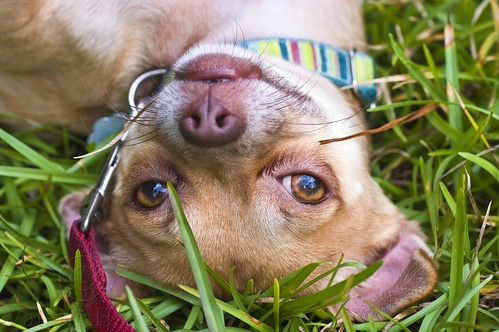
George rolling on grass, originally uploaded by Turtelle.

Jonathan Balcombe published Pleasurable Kingdom: Animals and the Nature of Feeling Good back in 2006, but I only just got around to reading it. Clifford bought it for me. I have to admit to experiencing mixed feelings upon first holding this book in my hands, and not because of what Balcombe wrote--I recommend this book highly to any animal-lover, armchair natural-historian or biologist--no, my trepidation and annoyance was due to the presence of a forward by Peter Singer, author of Animal Liberation, and apparently mentor to Ingrid Newkirk, founder and president of PETA, and a puff by Wayne Pacelle of HSUS. I had to wonder at Balcombe's taste.

I began by reading the foreward. Singer begins with an anecdote about dolphins surfing (not suffering), and goes on to say, "Despite such experiences--and growing up with a cat who certainly showed she liked being stroked--my focus has always been on animals' capacity to suffer, from the time I started thinking seriously about the ethics of how we treat them." He goes on to say, "But with all this emphasis on animal suffering, I and many others in the animal movement have neglected animals' capacity to enjoy their lives. Fortunately Jonathan Balcombe's book has restored the balance." I think that this book is excellent, thought-provoking, informative and an enjoyable read. I do not think that it has magically restored balance to the animal movement, and I offer as evidence the continued opposition to the No Kill movement of groups such as PETA and HSUS and of their respective leaders in particular.

Singer is clearly primarily interested in animals raised for food and for laboratory research. He does not mention the millions killed in shelters each year. I really wish that he had. He wrote about his cat. Pets are the animals whose capacity to enjoy life is most readily experienced , observed and shared by most people. Do Singer and others regard the tragic killing of millions of shelter pets as mere 'collateral damage' in their greater quest for a more perfect world? Most people with pets don't need to read a book to know that their dog or cat has the capacity to experience pleasure and the ability to seek it out. American 'shelters' deprive millions of animals of these things annually, and for no other reasons than laziness and adherence to entrenched and regressive views. The majority of these animals are not inevitably or irretrievably suffering. They're jsut homeless. They have the capacity to enjoy life. Singer could have said something about this. He maybe almost did. But he didn't. I'm disappointed in that, but he indicated a little chink in the old Benthamite armor. Suffering isn't the only thing. There is a whole 'nother facet to the lives of animals--pleasure. Hallellujah for that.

Balcombe begins the book with an exploration of how animals' capacity to experience pleasure is adaptive in the Darwinian sense, and how it is changing how we view animal minds and how animals are portrayed in the media.

For now, I'll leave you with a quote from the book:

"The mass media often perpetuate the stereotype that life is harsh and joyless for wild creatures. An article on Norwegian polar bears poisoned by toxic pollutants 'migrating' from industrial regions in the south describes the 'brutal, unforgiving' surroundings. 'From the moment of birth--even conception--animals here struggle against the odds. Most polar bears die before their first birthday.' It is sad that not all polar bears grow into adults, and a shame that humans are making things worse. And yet, a six month old polar bear has been suckled and nurtured by a protective mother, has experienced over 100 sunrises and sunsets, and probably hasn't bemoaned the transience of life. Most lives, even shortened ones, are probably better lived than not lived at all."

George, the dog in the picture above, is experiencing the pleasure of being alive. A few months ago, he was a skinny little guy on death row at a high-kill shelter in Georgia. He is part of the fortunate minority from that shelter. Most end up as rotting corpses in the county landfill, and that is unacceptable. He was lucky, but luck should have nothing to do with it.

Monday, August 17, 2009

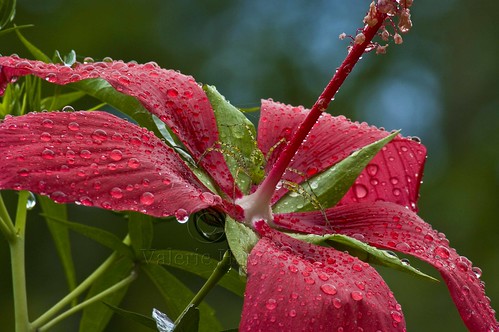
Hibiscus With Green Lynx Spider

I took this photo yesterday, immediately after a rain shower. The spider is a green lynx spider Peucetia viridans (Hentz). Now that I am becoming a more proficient and prolific photographer, I will try to post the "Photo of the Day" to this blog, which I have been neglecting in favor of Flickr. Here I will post more extensive information on the natural history of my photographic subjects, and the story behind each picture. This particular picture is an example of how macro photography enables you to notice things you would ordinarily overlook. I have a particular affinity for things ordinarily overlooked, and in general, I think I'm a pretty good observer, but I didn't even see this spider when I first took the picture. I was photographing the hibiscus and only noticed the spider whan I reviewed the images a few minutes later on the LCD screen. I would have liked to photograph the spider against the red petals, but then he probably positioned himself on the green sepal deliberately, so I didn't try to interfere. These spiders are known for preying on insects regarded as both harmful and desirable. They even make a habit of eating wasps and other stinging insects.